From Fragmented Insights to Clear Direction
CapMetro UX Research & Design Priorities
Team research project · Summer 2025
Design Research · Focus: interviews and synthesis
We studied how riders navigate CapMetro’s digital tools when planning a trip, paying fares, or looking for help under time pressure. I helped organize interview findings into recurring patterns so the team could turn scattered observations into priorities for a future redesign.
Overview
Problem
Solution
Outcome
Fragmented tools made information confusing
Synthesized user research to clarify needs and align direction
Research findings and prioritized opportunities for redesign
Context
Thousands of riders rely on CapMetro for commuting, errands, and events.
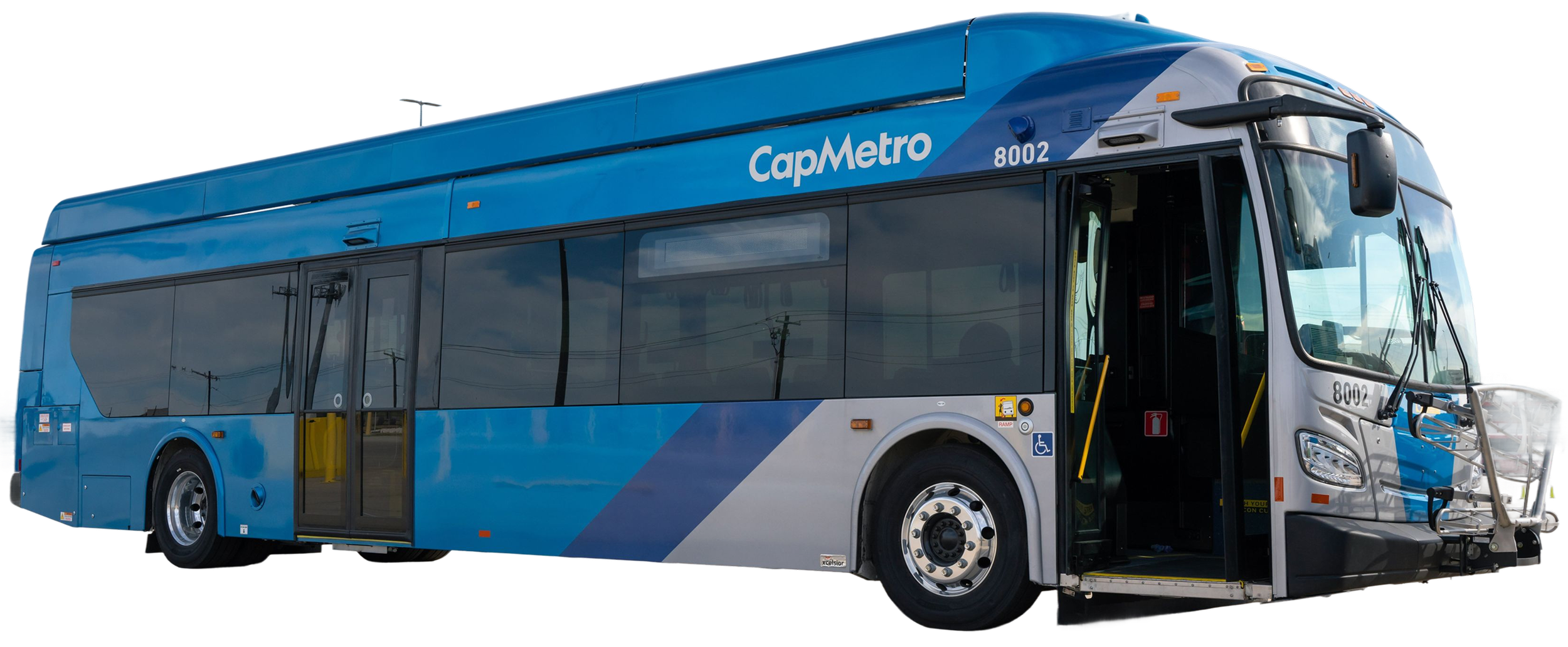
Our project examined an experience spread across three tools: the website for information, Transit for trip planning, and Umo for payments. Moving between them could make a single rider task harder to follow.
The Challenge
While the main focus was usability, the real challenge ended up being clarity.
While conducting research, insights accumulated quickly across interviews and observations. However, they did not align on common goals.
Different team members focused on different issues such as accessibility, trip planning, or fare payments.
While all were valid, there was no shared understanding of what mattered most.
The core challenge became: How do we turn scattered research into a clear direction?
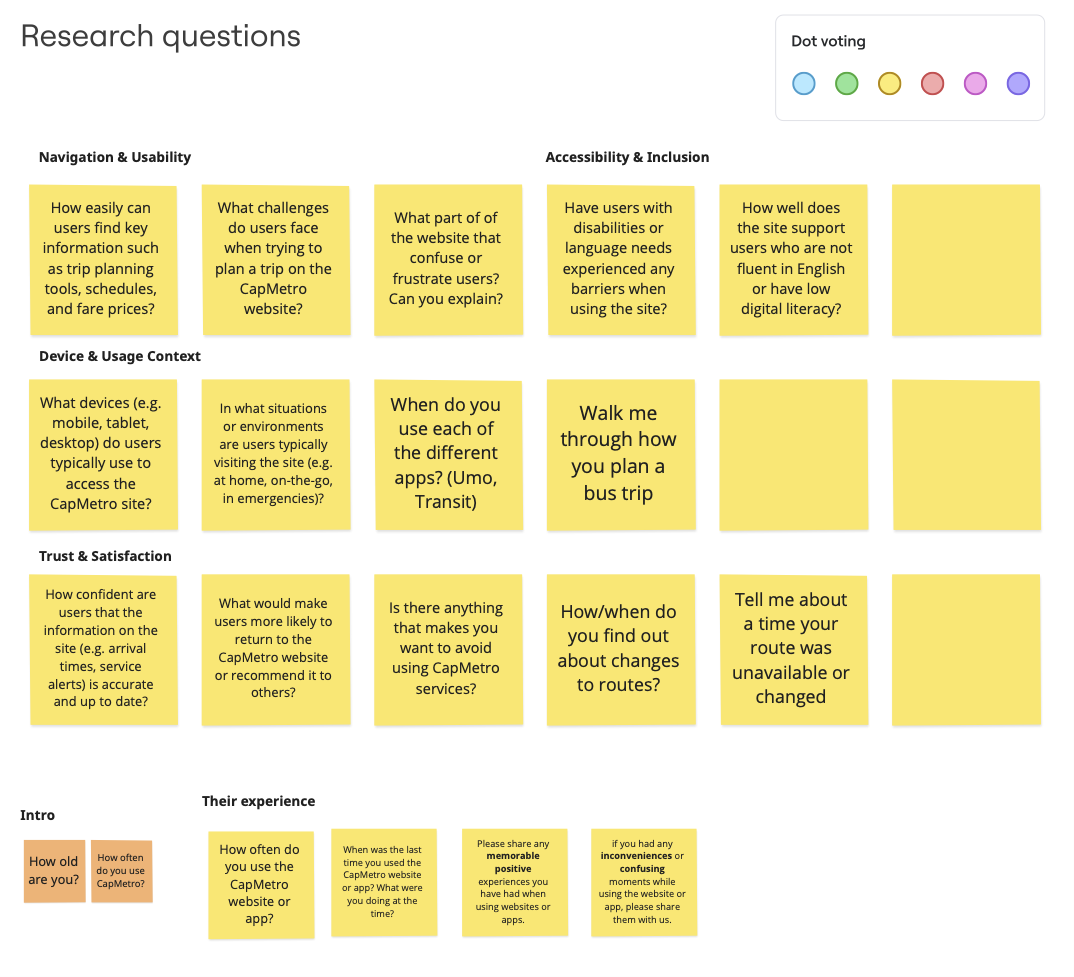
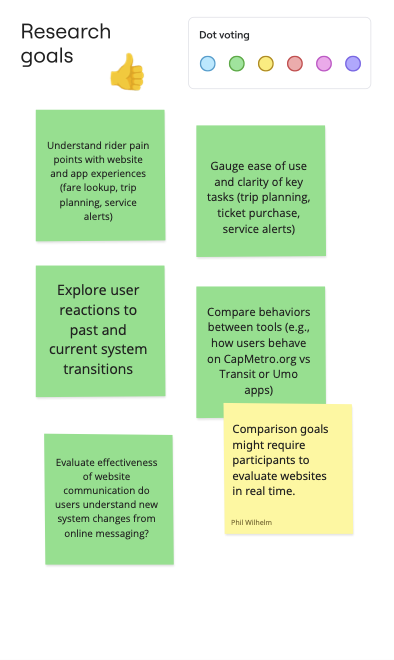
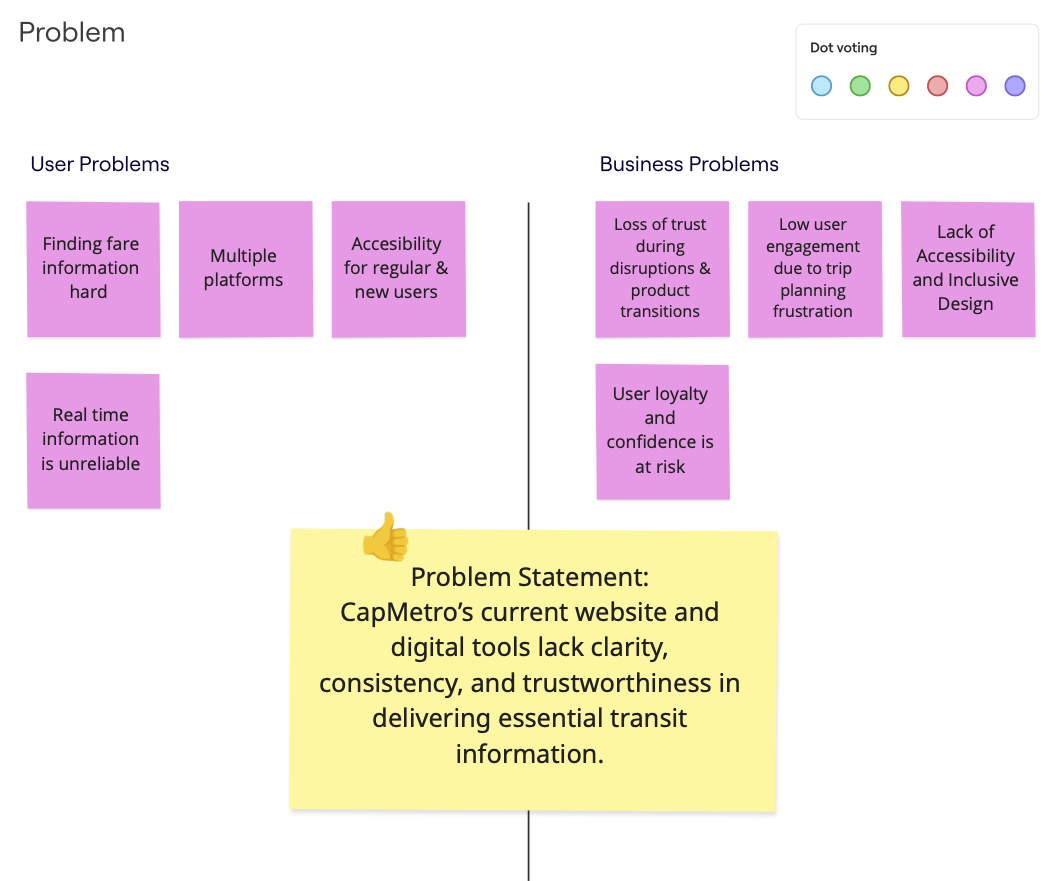
Team research board before synthesis: competing observations covered accessibility, trip planning, and fare payment.
My Role
Planning: Helped define the research approach and interview questions.
Interviewing: Contributed to participant interviews.
Synthesis: Organized observations into themes, connected behaviors to barriers, and helped translate findings into design priorities.
The research was a team effort; my focus was making the findings usable for design decisions.
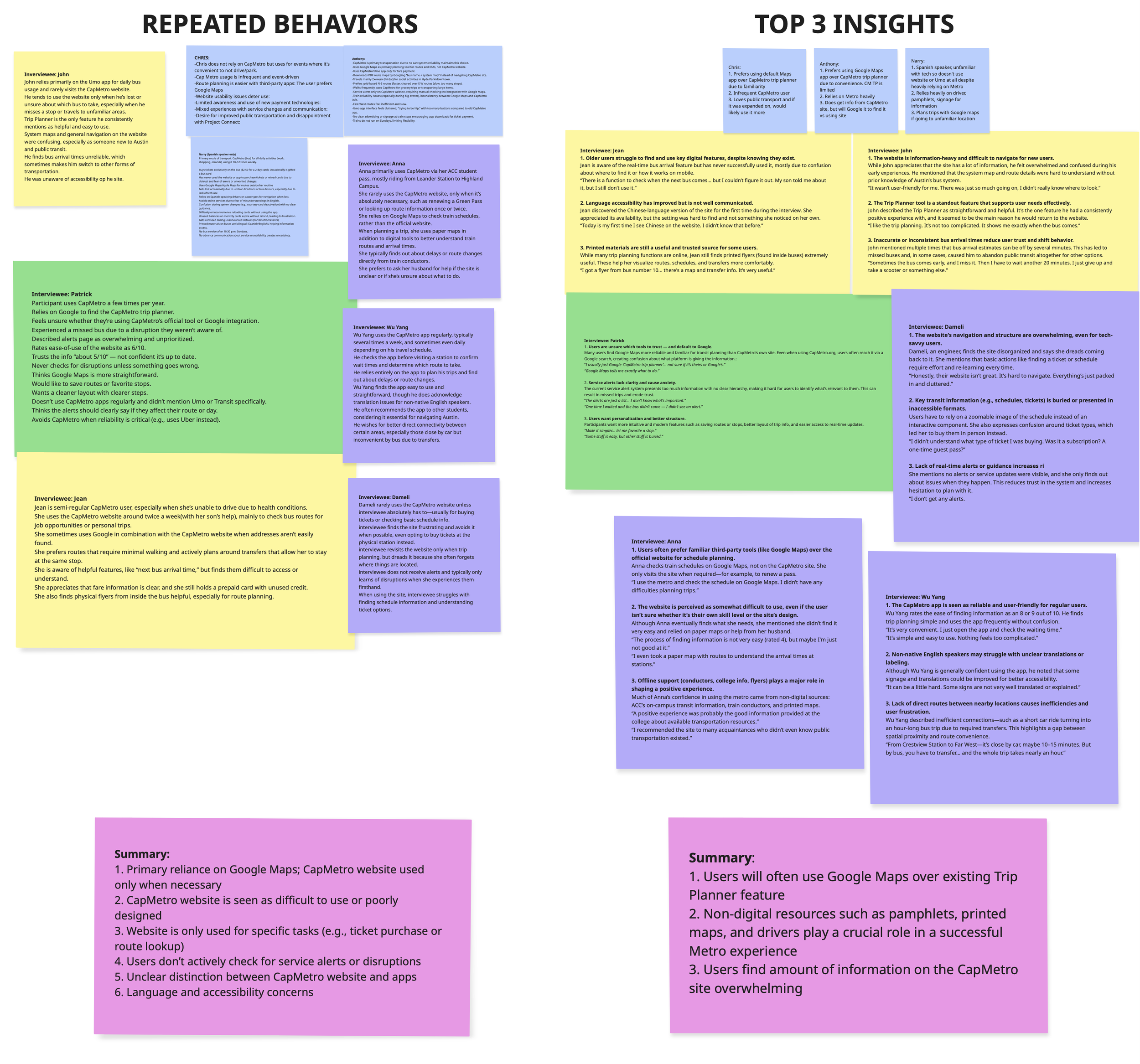
Synthesis board: recurring rider behaviors and insights grouped to identify patterns across interviews.
Research Approach
To reduce ambiguity, I helped structure our research around behavior and perception.
As a team, we focused on:
Trip planning and navigation behaviors
Transitions between platforms and their ease of use
Trust and accuracy in real-time information
Accessibility across diverse users
We conducted semi-structured interviews with 9 participants, including both frequent and occasional riders with varying levels of familiarity and technical comfort.
This approach allowed us to capture both what users do and how they experience the CapMetro experience..
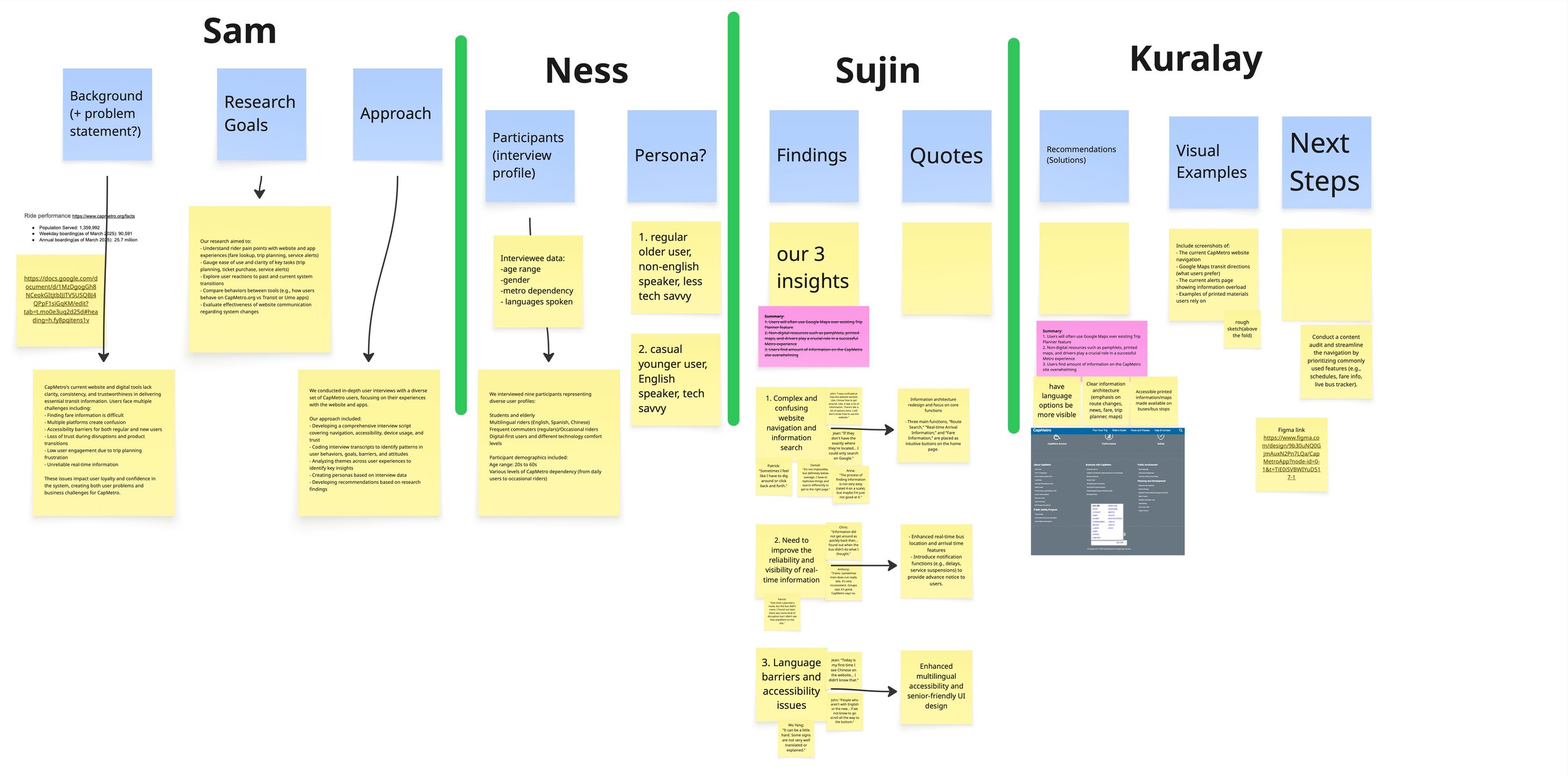
Research materials: interview screener, discussion protocol, and transcript excerpts used to collect and analyze rider experiences.
Understanding the User
CapMetro users represent a wide range of needs and contexts:
Students and commuters
Elderly or less tech-savvy users
Multilingual riders
Occasional riders and visitors
A key pattern emerged:
Many users interact with the system in moments of urgency — not casually, but when they are lost, confused, or under time pressure.
This reframed the problem:
The experience must prioritize clarity, speed, and immediate guidance.
Key Insights
1. Users rely on the system when they are lost
Many participants only used the website in stressful situations, such as missing a stop or not knowing which route to take. This makes simplicity and speed essential.
2. The ecosystem is too fragmented
Users must switch between multiple tools to complete a single task, creating confusion and cognitive overload.
3. Information overload reduces usability
Users reported:
Too many options
Difficulty understanding maps
Lack of clear hierarchy
Which makes it difficult for users to navigate effectively.
4. Trust in real-time data is inconsistent.
Uncertainty around arrival times impacts decision-making and increases frustration.
5. Accessibility is present but not discoverable
Features such as language options are present, but not easily accessible nor discoverable.
“I use the website when I’m lost.... I don’t know what bus to take.”
“There was a lot of information… I still don’t know how to use the website.”
“I didn’t know there was a Spanish option… it’s at the bottom.”
Turning Point:
Structuring the Data
As we moved on, I focused on organizing the research into meaningful patterns.
Rather than treating each observation individually, I grouped findings based on:
User goals and needs
Behaviors and tasks
Barriers and frustrations
Beliefs and perceptions
This shifted the team’s perspective from:
“What did users say?” to “What patterns are emerging across users?”
This shift created alignment and made it possible to define clear direction.
Synthesis
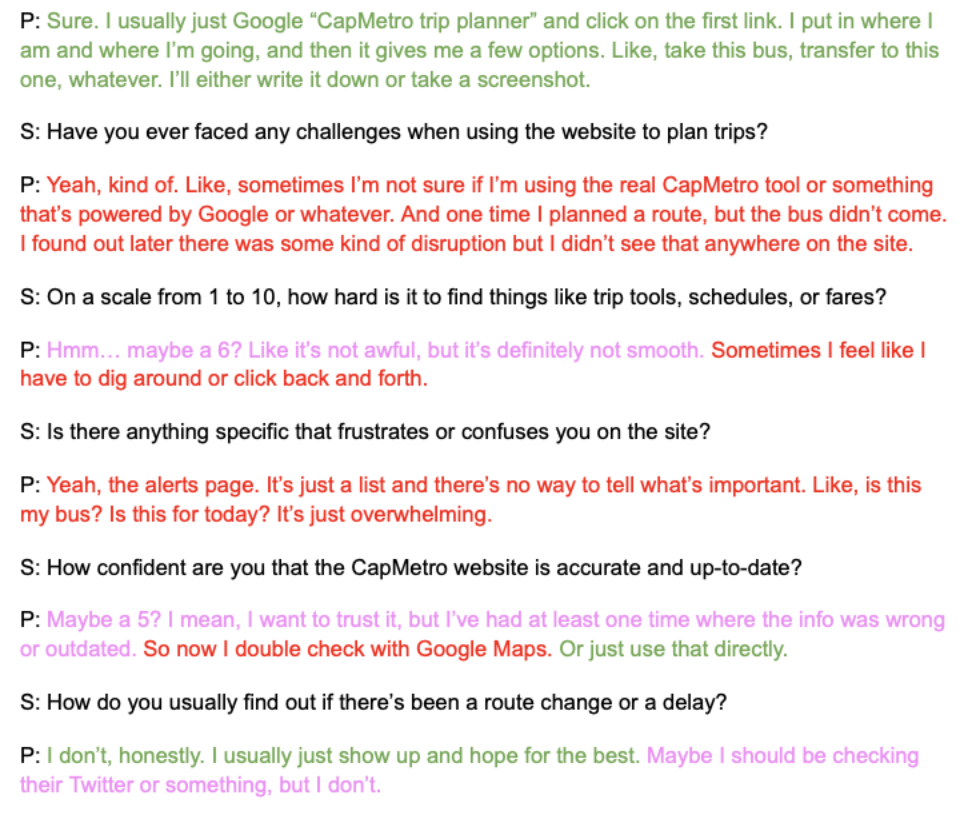
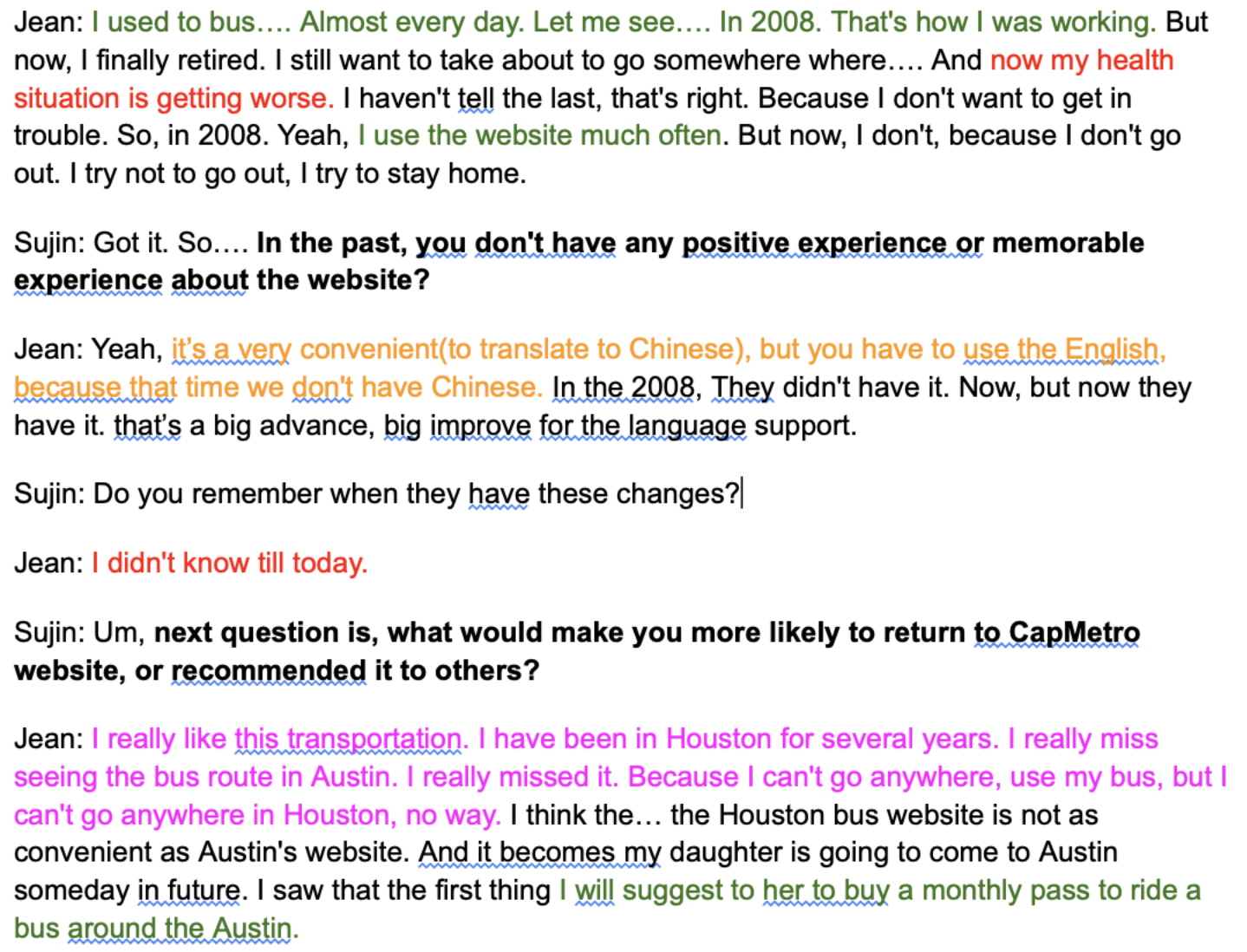
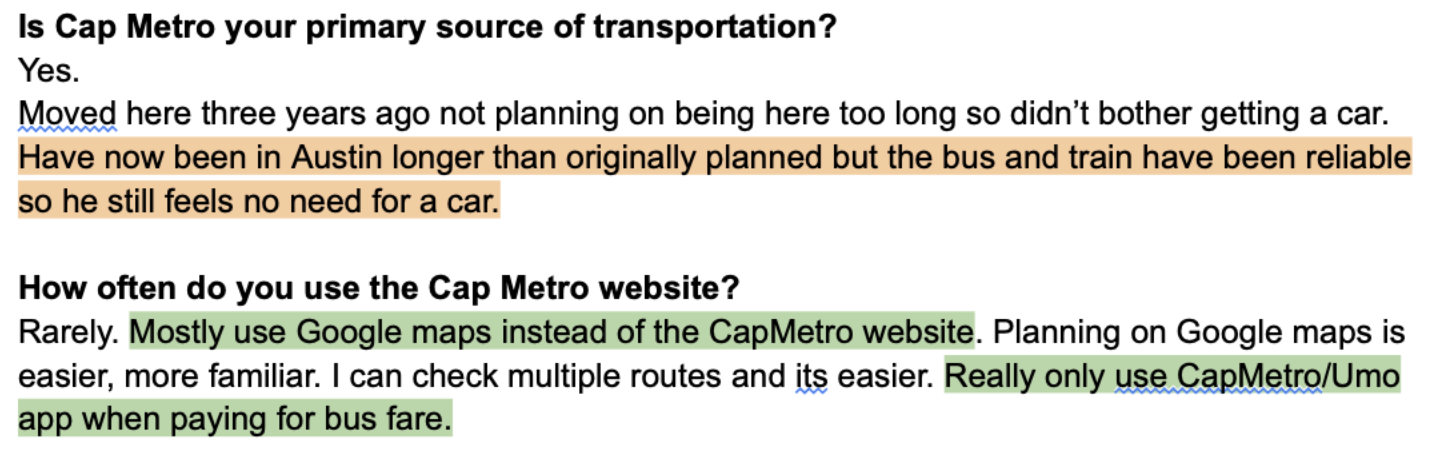
I led the effort to structure our findings through thematic and color coding:
Goals / Needs
Behaviors
Barriers
Beliefs
By organizing the data this way, I was able to:
Identify recurring patterns across participants
Connect surface-level behaviors to deeper frustrations
Transform raw data into structured understanding
Design Opportunities
From this structured understanding, we identified key opportunity areas:
Reduce platform fragmentation
Improve information hierarchy
Design for urgency and time-sensitive use
Increase trust and transparency
Enhance accessibility visibility
Outcome
The team delivered interview findings, research artifacts, a coding framework, synthesized themes, and priorities for a future redesign. Organizing observations around rider goals, behaviors, barriers, and beliefs gave us a shared basis for deciding what to address.
The priorities were clearer trip-planning guidance, easier transitions between tools, more visible accessibility options, and more transparent arrival information. This project establishes research direction; it does not demonstrate a measured improvement in the live interface.
Reflection
This project reinforced a key principle:
Clarity comes from structure.
I learned that:
Users interact with systems under real constraints, not ideal conditions
Clarity is more important than completeness
Designing for urgency requires prioritization, not more features
Most importantly, I strengthened my ability to:
Extract meaning from complex qualitative data
Identify patterns across diverse users
Translate research into actionable direction
This project showed me that research is not simply gathering information, it is also structuring it in a way that enables better decisions and grounds them in real user needs.
One of my strengths as a designer is clarifying complexity in projects and in how teams understand them.